Parameters
753.3B total / 43.0B active
MoE: total / active
Architecture
MoE with IndexShare sparse attention (DSA) + MTP layer
Released
25.08.2026
License
GLM-5.3 License
Input Modalities
Output Modalities
Context (native)
1,048,576 tokens
Context (extended)
1,048,576 tokens
About
GLM-5.3 (zai-org/GLM-5.3) is Z.ai's flagship open-weights coding and cyber-capable model - the same 753B-total / 43B-activated MoE base model as GLM-5.2 (IndexShare sparse attention (DSA) + Multi-Token Prediction layer, 1,048,576-token context), where every gain comes from post-training targeting complex coding and long-horizon agentic tasks. Released August 25, 2026.
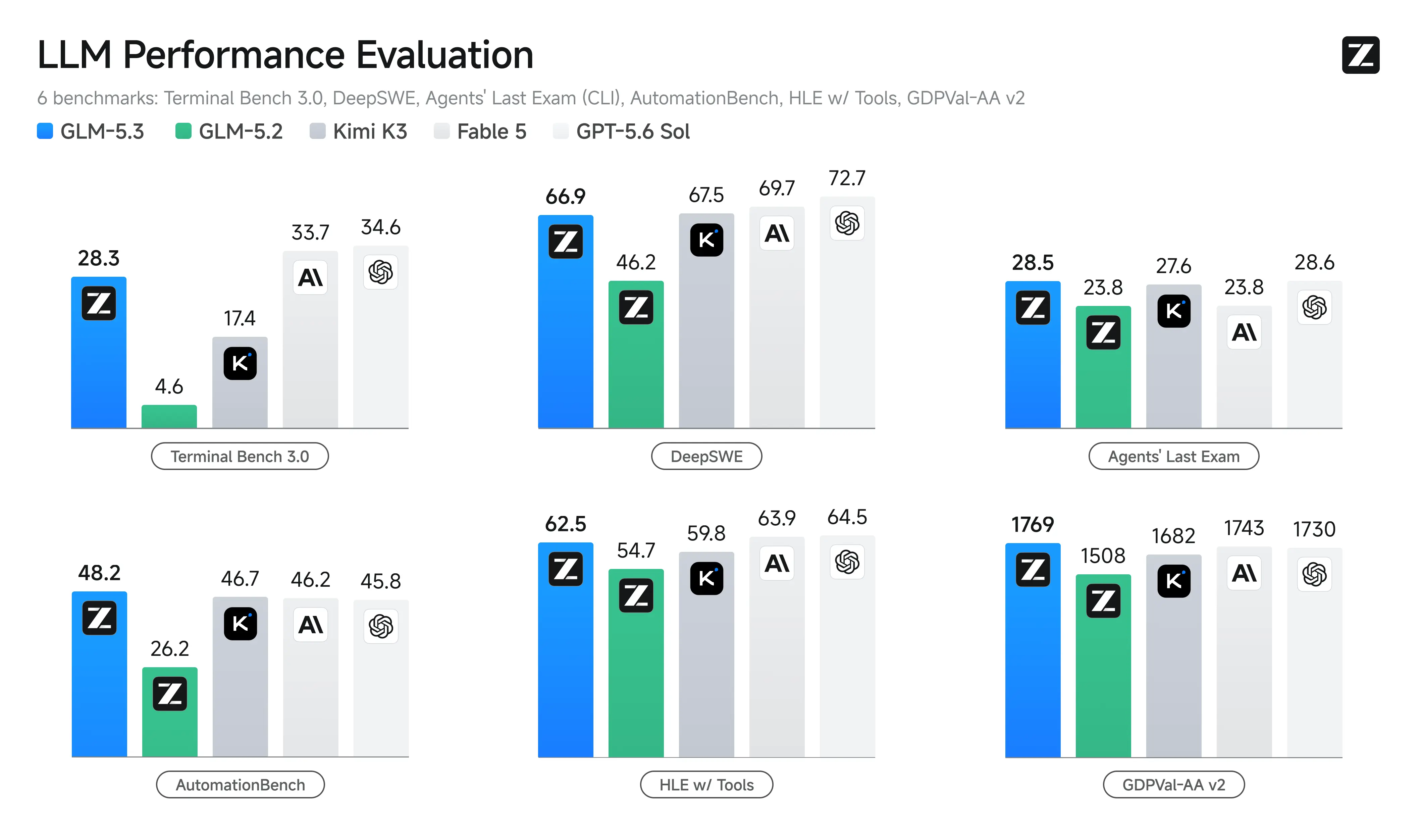
It is the most capable open-weights model for coding: a 50% improvement over GLM-5.2 on the in-house Z.ai Code Bench, and open-source SOTA on public benchmarks including Terminal Bench 3.0 and Agents' Last Exam. As post-training scaled, an emergent cyber capability developed faster than expected: GLM-5.3 is state of the art on CyberGym for vulnerability discovery, and its gains are largest further up the exploitation chain, more than doubling GLM-5.2 on exploitation benchmarks (ExploitGym, ExploitBench). Thinking budget is controllable via the reasoning_effort parameter (low/high/max, default max), and the chat template's clear_thinking defaults to false for chat scenarios to pass explicitly.
Training Data Same base model as GLM-5.2; every gain comes from post-training targeting complex coding and long-horizon agentic tasks
Benchmark Scores
| Benchmark | Score | Date |
|---|---|---|
|
Terminal Bench 2.1
coding_agent
|
97.34%
|
28.08.2026 |
|
Terminal-Bench 3.0
coding_agent
|
79.00%
|
28.08.2026 |
|
DeepSWE 1.1
coding_agent
|
88.97%
|
28.08.2026 |
|
NL2Repo
coding_agent
|
73.38%
|
28.08.2026 |
|
ProgramBench
coding_agent
|
23.22%
|
28.08.2026 |
|
SWE-Marathon
coding_agent
|
84.69%
|
28.08.2026 |
|
PostTrainBench
coding_agent
|
91.13%
|
28.08.2026 |
|
Cybergym
general_agent
|
92.71%
|
28.08.2026 |
|
ExploitGym (2h)
cybersecurity
|
45.05%
|
28.08.2026 |
|
ExploitGym (6h)
cybersecurity
|
38.95%
|
28.08.2026 |
|
Toolathlon Verified
general_agent
|
90.22%
|
28.08.2026 |
|
Automation-Bench
general_agent
|
85.00%
|
28.08.2026 |
|
Agents' Last Exam
general_agent
|
84.43%
|
28.08.2026 |
|
HLE (with tools)
stem_reasoning
|
95.76%
|
28.08.2026 |
|
GDPVal-AA v2
general_agent
|
96.61%
|
28.08.2026 |
|
SWE-bench Multilingual
coding_agent
|
90.30%
|
28.08.2026 |
|
SWE-bench Pro
coding_agent
|
80.75%
|
28.08.2026 |
|
DeepSWE
coding_agent
|
92.02%
|
28.08.2026 |
|
SWE Atlas - QnA
coding_agent
|
85.04%
|
28.08.2026 |
|
SWE Atlas - TW
coding_agent
|
70.30%
|
28.08.2026 |
|
SWE Atlas - RF
coding_agent
|
85.46%
|
28.08.2026 |
|
Terminal-Bench 2.1 (Terminus-2)
coding_agent
|
99.11%
|
28.08.2026 |
|
Harbor-Index
coding_agent
|
65.13%
|
28.08.2026 |
|
Hy-Backend 2.0 (Internal)
coding_agent
|
67.09%
|
28.08.2026 |
|
Hy-SWE Max Verified (Internal)
coding_agent
|
86.26%
|
28.08.2026 |
|
Hy-CompanyBench V2 (Internal)
general_agent
|
80.89%
|
28.08.2026 |
|
WideSearch
general_agent
|
93.93%
|
28.08.2026 |
|
$OneMillion-Bench
general_capabilities
|
86.31%
|
28.08.2026 |
|
DRACO
general_agent
|
55.13%
|
28.08.2026 |
|
Hy-LifeSearch (Internal)
general_agent
|
42.04%
|
28.08.2026 |
|
Hy-BrowseComp-Pro2 (Internal)
general_agent
|
12.84%
|
28.08.2026 |
|
OfficeQA Pro
general_agent
|
98.57%
|
28.08.2026 |
|
MCP-Atlas
general_agent
|
94.80%
|
28.08.2026 |
|
Apex-Agents
general_agent
|
89.78%
|
28.08.2026 |
|
SkillsBench Avg5
coding_agent
|
94.54%
|
28.08.2026 |
|
JobBench
general_agent
|
78.79%
|
28.08.2026 |
|
WorkSpaceBench
general_agent
|
59.52%
|
28.08.2026 |
|
BankerToolBench
general_agent
|
77.22%
|
28.08.2026 |
|
E-Bench (Internal)
general_agent
|
71.34%
|
28.08.2026 |
|
E-Bench-Code (Internal)
coding_agent
|
11.58%
|
28.08.2026 |
|
Hy-FinAgentBench (Internal)
domain_finance
|
80.74%
|
28.08.2026 |
|
Hy-FinmodelBench v2 (Internal)
domain_finance
|
78.07%
|
28.08.2026 |
|
BioMysteryBench
stem_reasoning
|
77.47%
|
28.08.2026 |
|
CritPt (no tools)
stem_reasoning
|
58.36%
|
28.08.2026 |
|
GPQA Diamond
stem_reasoning
|
95.08%
|
28.08.2026 |
|
Humanity's Last Exam
stem_reasoning
|
76.14%
|
28.08.2026 |
|
SUPERChem
stem_reasoning
|
24.48%
|
28.08.2026 |
|
FrontierSWE
coding_agent
|
82.94%
|
28.08.2026 |
|
ExploitBench
cybersecurity
|
55.97%
|
28.08.2026 |
Model Tree, Spaces and Paper
Model tree for zai-org/GLM-5.3
Finetunes
Quantizations
Spaces using zai-org/GLM-5.3 13
Collection including zai-org/GLM-5.3
[
GLM-5.3
Collection
4 items • Updated 15 days ago • 42
](https://huggingface.co/collections/zai-org/glm-53)
Paper for zai-org/GLM-5.3
[
GLM-5: from Vibe Coding to Agentic Engineering
Paper • 2602.15763 • Published Feb 17 • 221
](https://huggingface.co/papers/2602.15763)
Citation
Citation
If you find GLM-5.3 useful in your research, please cite our technical report:
@misc{glm5team2026glm5vibecodingagentic,
      title={GLM-5: from Vibe Coding to Agentic Engineering},
      author={GLM-5-Team and : and Aohan Zeng and Xin Lv and Zhenyu Hou and Zhengxiao Du and Qinkai Zheng and Bin Chen and Da Yin and Chendi Ge and Chenghua Huang and Chengxing Xie and Chenzheng Zhu and Congfeng Yin and Cunxiang Wang and Gengzheng Pan and Hao Zeng and Haoke Zhang and Haoran Wang and Huilong Chen and Jiajie Zhang and Jian Jiao and Jiaqi Guo and Jingsen Wang and Jingzhao Du and Jinzhu Wu and Kedong Wang and Lei Li and Lin Fan and Lucen Zhong and Mingdao Liu and Mingming Zhao and Pengfan Du and Qian Dong and Rui Lu and Shuang-Li and Shulin Cao and Song Liu and Ting Jiang and Xiaodong Chen and Xiaohan Zhang and Xuancheng Huang and Xuezhen Dong and Yabo Xu and Yao Wei and Yifan An and Yilin Niu and Yitong Zhu and Yuanhao Wen and Yukuo Cen and Yushi Bai and Zhongpei Qiao and Zihan Wang and Zikang Wang and Zilin Zhu and Ziqiang Liu and Zixuan Li and Bojie Wang and Bosi Wen and Can Huang and Changpeng Cai and Chao Yu and Chen Li and Chengwei Hu and Chenhui Zhang and Dan Zhang and Daoyan Lin and Dayong Yang and Di Wang and Ding Ai and Erle Zhu and Fangzhou Yi and Feiyu Chen and Guohong Wen and Hailong Sun and Haisha Zhao and Haiyi Hu and Hanchen Zhang and Hanrui Liu and Hanyu Zhang and Hao Peng and Hao Tai and Haobo Zhang and He Liu and Hongwei Wang and Hongxi Yan and Hongyu

(section continues in the model card)
Footnotes (benchmark methodology)
Footnotes
- HLE w/ tools: We use sampling parameters of
temperature=1.0andtop_p=0.95for evaluation, with a maximum generation length of163,840tokens. The evaluation is conducted with a maximum context length of300,000tokens, using a context management strategy. We use GPT-5.6-luna (medium) as the judge model. - NL2Repo: We evaluated NL2Repo with
temperature=1.0,top_p=1.0, andmax_new_tokens=64kunder 1M context. To prevent hacking, we use rule-based and a LLM-based judgement to prevent malicious behaviors (e.g., unauthorized pip or curl operations). - DeepSWE: We run DeepSWE using the mini-swe-agent harness with
temperature=0.95,top_p=1.0,timeout=6hand 400K context. - Terminal-Bench 2.1: We evaluate in Claude Code 2.1.207 with
temperature=1.0,top_p=1,max_new_tokens=65536with 6h timeout. - Terminal-Bench 3.0: We evaluate Terminal-Bench-3 tasks with the Claude Code 2.1.207 harness (reasoning effort=max, 400K context, and 128K maximum output), reporting avg@3 over three rollouts per task. Each rollout runs in an isolated container built from the task's official image, and is capped at 600 agent turns with a 10-hour timeout. Tool Search is disabled, and the artifacts each agent produces are scored by the task's official separate verifier.
- Agent's Last Exam (CLI): We evaluate ALE using the official evaluation protocol with the Claude Code harness (reasoning effort=max, 1M context, and 64K maximum output). Each of the 105 tasks runs in an isolated Docker container using the resources declared in its Task Card. The default timeout is 4 hours, with task-specific limits taking precedence (up to 8 hours). Tool Search is disabled, and results are scored by the official ALE evaluators.
- Toolathlon Verified: We obtain all results via the official evaluation service and report pass@1 averaged over 3 independent runs.
- AutomationBench: We evaluate on AutomationBench v1.0.6, incorporating the fix for the
null-type handling issue introduced in PR #13. - GDPval-AA v2: Models are evaluated by Artificial Analysis.
- CyberGym: We evaluate GLM-5.3 in Claude Code 2.1.207 (max reasoning effort, no web tools with
temperature=1.0,top_p=1.0,max_new_tokens=128000). All evaluations are under unlimited timeout per task and results are single-run Pass@1 over 1,507 tasks. To simulate real-world usage scenarios, we place the agent inside the task container. We also remove all Git-related information and apply a domain whitelist (allowing only essential domains such as pypi.org and deb.debian.org for basic tool installation) to prevent the agent from cheating. - ExploitGym: We evaluate GLM-5.3, Kimi-K3 and Qwen3.8 Max in Claude Code 2.1.207 (max reasoning effort, no web tools with
temperature=1.0,top_p=1.0,max_new_tokens=128000). The reported results are single-run Pass@1 on 869 tasks under two timeout budgets: 2 hours and 6 hours, which are calculated as the API inference time rescaled by per-model tokens per second rate (per-model TPS sourced from Artificial Analysis; that is, we rescale GLM-5.3's results by 115 TPS, Kimi K3's results by 40 TPS and Qwen3.8 Max's results by 47 TPS), plus the non-API overhead. We also apply a domain whitelist (allowing only essential domains such as pypi.org and deb.debian.org for basic tool installation) to prevent the agent from cheating. - ExploitBench: We evaluate GLM-5.3 in Claude Code 2.1.207 (max reasoning effort, no web tools with
temperature=1.0,top_p=1.0,max_new_tokens=128000). Following the official evaluation settings, we limit the maximum number of interaction rounds between the agent and the environment to 300, and compute the average coverage score over all 41 tasks across 3 revisions. The coverage result of a task is determined by taking the union of capabilities achieved across all revisions, and the average score is obtained by averaging the results. We also apply a domain whitelist (allowing only essential domains such as pypi.org and deb.debian.org for basic tool installation) to prevent the agent from cheating. - FrontierSWE: The evaluation was conducted by Proximal with 1M context length, max effort level, and 128K maximum output tokens. Dominance score reported as of 2026/08/14.
- PostTrainBench: We evaluate GLM-5.3 using Claude Code 2.1.207 with max effort level,
temperature = 1.0,top_p = 1.0,max_new_tokens = 128000, and a 1M-token context window. We report the weighted average over 3 runs. Runs that fail to produce a score fall back to the official zero-shot base-model baseline score. For checks intended to prevent the use of third-party APIs, we removed the original pattern-matching-based checks, as they produced false positives when a local vLLM endpoint was accessed through the OpenAI SDK. Instead, we use an LLM agent to inspect solutions for external API usage. - SWE-Marathon: We evaluate GLM-5.3 using Claude Code 2.1.207 with maximum effort level,
temperature = 1.0,top_p = 0.95,max_new_tokens = 128000, and a 1M-token context window. Forstrip-clone, the original anti-cheat checks used overly broad import detection that could reject valid implementations. We removed the affected checks and performed llm-based inspection instead to avoid false positiv
(section continues in the model card)
Note (reasoning_effort, clear_thinking)
Note
- GLM-5.3 supports controlling the thinking budget through the
reasoning_effortparameter, which accepts three levels:low,high, andmax. It defaults tomaxif not passed (or if set to any other value). To useloworhigh, pass them explicitly. For benchmark and leaderboard reproduction, keep the defaultmax. - In the chat template for GLM-5.3,
clear_thinkingdefaults tofalseif not passed. For chat scenarios, explicitly passclear_thinking=true.
Serve GLM-5.3 Locally (SGLang, vLLM, Ascend NPU...)
Serve GLM-5.3 Locally
GLM-5.3 supports deployment with the following frameworks. Feel free to try them out:
- SGLang — see cookbook
- vLLM — see recipes
- TokenSpeed — see here
- Transformers — see transformers docs
- KTransformers — see tutorial
- Unsloth — see guide
- For deployment on the
Ascend NPUplatform, inference frameworks such as vLLM-Ascend, xLLM and SGLang are supported — see here.
Benchmark (vs GLM-5.2, Kimi K3, DeepSeek-V4, GPT-5.6 etc.)
Benchmark
| Benchmark | GLM-5.3 | GLM-5.2 | Kimi K3 | DeepSeek-V4 Pro-0813 | Qwen3.8-Max | Opus 4.8 | Fable 5 (w/ fallback) | GPT-5.6 Sol |
|---|---|---|---|---|---|---|---|---|
| Terminal Bench 2.1 | 88.2 | 81.0 | 88.3 | 87.9 | 86.6 | 85.0 | 88.0 | 88.8 |
| Terminal Bench 3.0 | 28.3 | 4.6 | 17.4 | – | – | 21.1 | 33.7 | 34.6 |
| DeepSWE (v1.1) | 66.9 | 46.2 | 67.5 | 62.7 | 56.6 | 58.0 | 69.7 | 72.7 |
| NL2Repo | 58.0 | 48.9 | 58.0 | 61.1 | 55.9 | 69.7 | – | – |
| ProgramBench (Almost Solved) | 19.0 | 9.5 | 17.5 | – | 10.5 | 15.5 | 33.0 | 23.0 |
| FrontierSWE | 78.1 | 67.5 | – | – | – | 66.5 | 88.2 | – |
| SWE-Marathon (v1.1) | 42.5 | 19.4 | 48.1 | – | – | 48.8 | 33.1 | 42.5 |
| PostTrainBench | 39.8 | 31.7 | 32.0 | – | – | 32.9 | 41.8 | 36.2 |
| CyberGym | 84.5 | 77.2 | 80.0 | 83.3 | 78.5 | 78.1 | 83.8 | 83.6 |
| ExploitGym (2h / 6h) | 105 / 130 | 29 / 39 | 36 / 70 | – | 14 / 26 | 80 / 120 | 181 / 247 | 216 / 293 |
| ExploitBench | 54.4 | 24.4 | 32.2 | – | 28.8 | 40.0 | 78.0 | 76.5 |
| Toolathlon Verified | 73.0 | 59.9 | 76.5 | 74.1 | 72.5 | 76.2 | 74.7 | 74.9 |
| AutomationBench (v1.0.6) | 48.2 | 26.2 | 46.7 | 43.2 | 39.8 | 41.0 | 46.2 | 45.8 |
| Agents' Last Exam (ALE-CLI) | 28.5 | 23.8 | 27.6 | 25.7 | 27.0 | 25.7 | 23.8 | 28.6 |
| HLE w/ Tools | 62.5 | 54.7 | 59.8 | 60.0 | 56.2 | 57.9 | 63.9 | 64.5 |
| GDPval-AA v2 | 1769 | 1508 | 1682 | 1590 | 1739 | 1588 | 1743 | 1730 |
Introduction (coding + emergent cyber capability)
GLM-5.3
GLM-5.3 uses the same base model as GLM-5.2 — every gain comes from post-training. Compared with GLM-5.2, it is much better at complex coding and long-horizon tasks:
- Stronger Coding: GLM-5.3 is the most capable open-weights model for coding, with a 50% improvement over GLM-5.2 on our in-house Z.ai Code Bench. It also achieve open-source SOTA on public benchmarks including Terminal Bench 3.0 and Agents' Last Exam.
- Emergent Cyber Capability: As we scaled post-training, cyber capability developed faster than we expected. GLM-5.3 is state of the art on CyberGym for vulnerability discovery, and its gains are largest further up the exploitation chain, where it more than doubles GLM-5.2 on exploitation benchmarks.
Architecture
- Attention
- Sparse Attention
- MoE
- 256 experts · top-8 per token
- Layers
- 78
- Hidden size
- 6144
- Context
- 1M tokens
- Parameters
- 753329.9M
- Active params
- 43046.5M
Source: Hugging Face config.json · GlmMoeDsaForCausalLM · model repo
Training Pipeline
-
2
rl
Agentic post-training (coding + long-horizon/cyber RL)
GLM-5.3 reuses the GLM-5.2 base model; all capability gains come from scaled post-training. Key outcomes: strongest open-weights coding model (+50% over GLM-5.2 on in-house Z.ai Code Bench; open-source SOTA on Terminal-Bench 3.0 and Agents' Last Exam), emergent cyber capability (SOTA on CyberGym vulnerability discovery; more than doubles GLM-5.2 on exploitation benchmarks ExploitGym/ExploitBench). Supports reasoning_effort low/high/max (default max) and clear_thinking.
Training & Evaluation Datasets
| Name | Role | Size | Modalities | Collection |
|---|---|---|---|---|
| Post-training corpus (coding, long-horizon agentic, cyber) | rl | — | — |
Linked Resources
GLM-5: from Vibe Coding to Agentic Engineering (technical report, arXiv:2602.15763)
https://arxiv.org/abs/2602.15763
zai-org/GLM-5 — GLM-5 & GLM-5.3 code, examples and resources
https://github.com/zai-org/GLM-5
Transformers docs: GlmMoeDsa (GLM-5.3 architecture)
https://github.com/huggingface/transformers/blob/main/docs/source/en/model_doc/glm_moe_dsa.md
SGLang cookbook: GLM-5.3
https://cookbook.sglang.io/autoregressive/GLM/GLM-5.3
vLLM recipes: GLM-5.3
https://recipes.vllm.ai/zai-org/GLM-5.3
TokenSpeed recipe: GLM-5.3
https://lightseek.org/tokenspeed/recipes/models#glm-5-3
KTransformers tutorial: GLM-5.2/5.3
https://github.com/kvcache-ai/ktransformers/blob/main/doc/en/kt-kernel/GLM-5.2-Tutorial.md
Unsloth guide: GLM-5.3
https://unsloth.ai/docs/models/GLM-5.3
Ascend NPU deployment (vLLM-Ascend, xLLM, SGLang)
https://github.com/zai-org/GLM-5/blob/main/example/ascend.md
BibTeX citation: GLM-5 technical report (GLM-5-Team, 2026)
https://arxiv.org/abs/2602.15763
Trend Analysis
24h Change
+42.6%
Current
94,403
likes
+3.8%
downloads_all_time
+42.6%
followers
+0.4%
downloads
+16.9%
Usage & Social Metrics
| Source | Metric | Value | Period | Recorded |
|---|---|---|---|---|
| ollama | downloads | 24,900 pulls | daily | 01.09.2026 |
| huggingface | downloads_all_time | 94,403 | daily | 01.09.2026 |
| huggingface | followers | 20,001 | daily | 01.09.2026 |
| huggingface | likes | 1,466 | daily | 01.09.2026 |
| huggingface | downloads | 94,403 | daily | 01.09.2026 |
| ollama | downloads | 21,300 pulls | daily | 31.08.2026 |
| huggingface | downloads_all_time | 66,195 | daily | 31.08.2026 |
| huggingface | followers | 19,927 | daily | 31.08.2026 |
| huggingface | likes | 1,412 | daily | 31.08.2026 |
| huggingface | downloads | 66,195 | daily | 31.08.2026 |
| ollama | downloads | 14,700 pulls | daily | 30.08.2026 |
| huggingface | downloads_all_time | 50,116 | daily | 30.08.2026 |
| huggingface | followers | 19,819 | daily | 30.08.2026 |
| huggingface | likes | 1,334 | daily | 30.08.2026 |
| huggingface | downloads | 50,116 | daily | 30.08.2026 |
| ollama | downloads | 10,100 pulls | daily | 29.08.2026 |
| huggingface | followers | 19,739 | daily | 29.08.2026 |
| huggingface | likes | 1,265 | daily | 29.08.2026 |
| huggingface | downloads | 8,804 | daily | 29.08.2026 |