Parameters
2.5B
Architecture
LlamaForCausalLM
Released
08.09.2026
License
Apache License 2.0
Input Modalities
Output Modalities
Context (native)
131,072 tokens
Context (extended)
131,072 tokens
About
MiniCPM5-2B (openbmb/MiniCPM5-2B, released September 8, 2026 under the Apache 2.0 License) is the second model in the MiniCPM5 series - a dense 2B Transformer (2.52B parameters) built for on-device, local deployment and resource-constrained scenarios, reaching 2B-class open-source SOTA (average score 53.9 in its comparison set, exceeding even the larger models listed, highest of which scores 51.1). It stays competitive with 4B-class models overall, with advantages in coding, mathematics, long-context understanding, tool use and agentic tasks, and provides native long-context support (128K context).
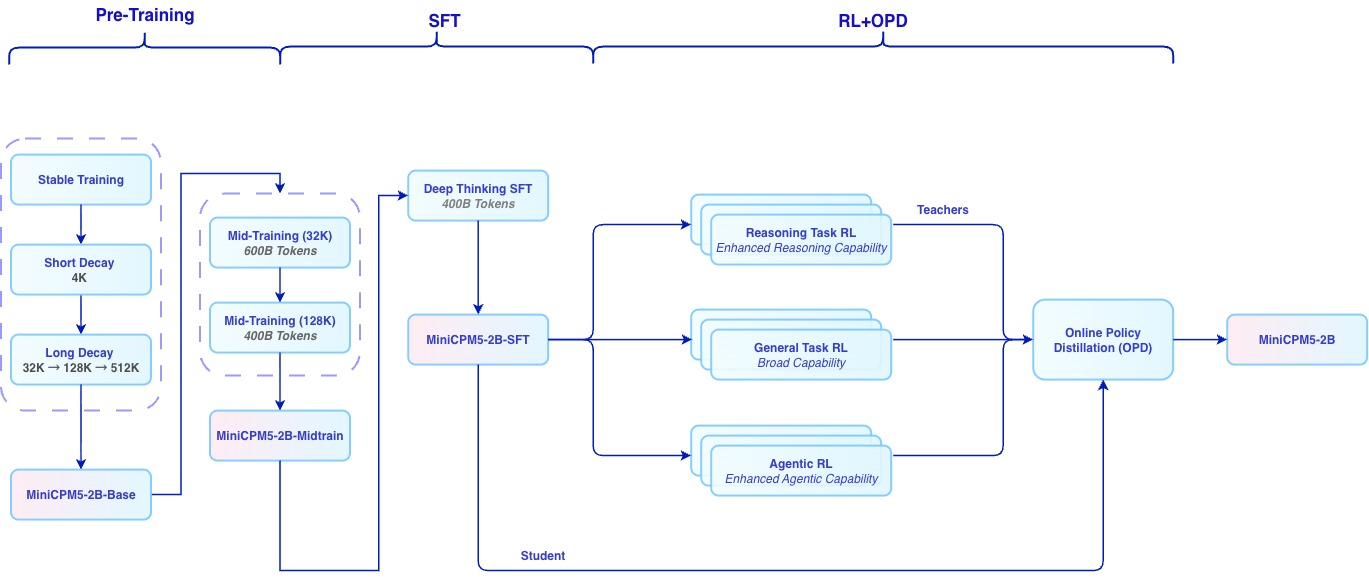
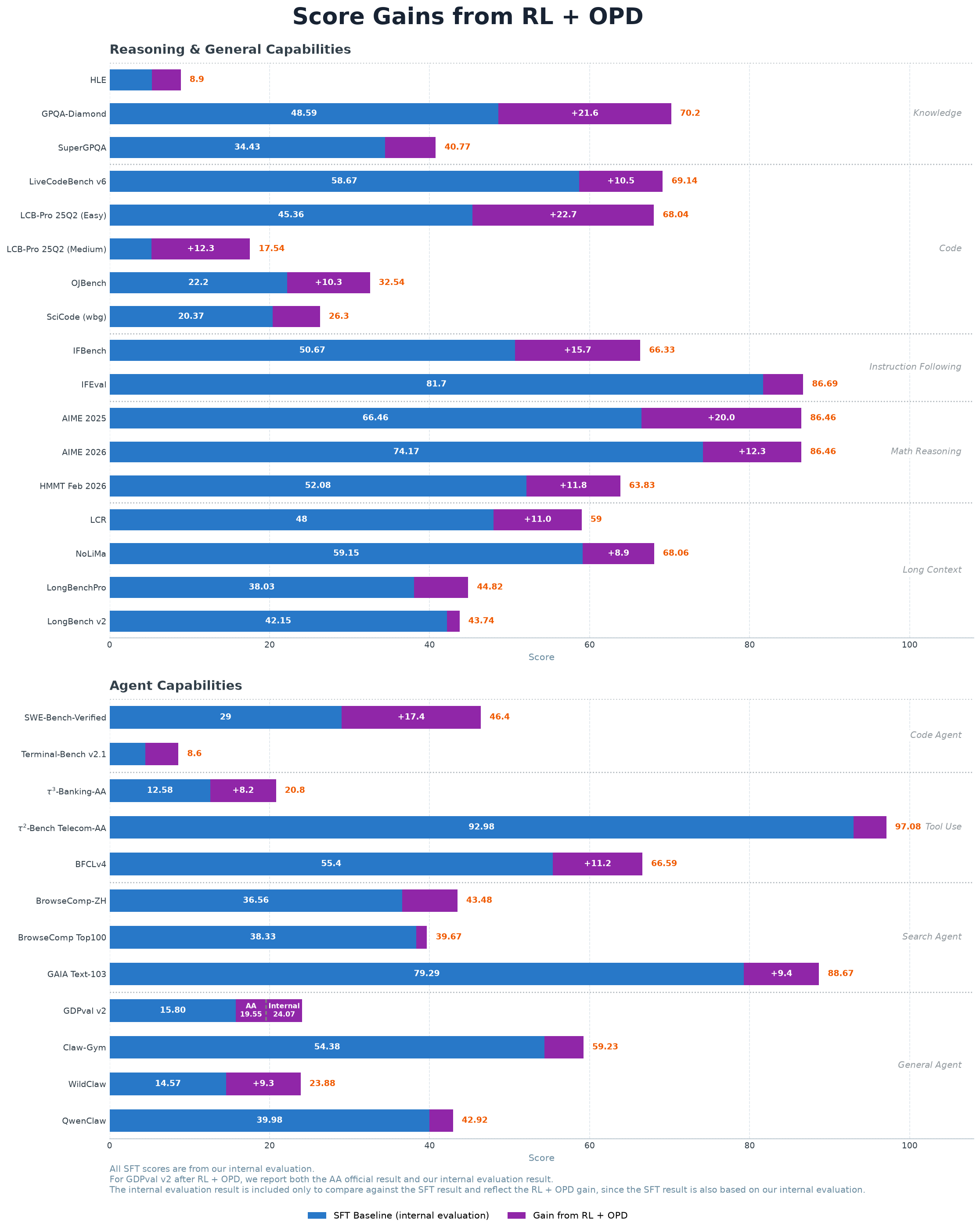
Its training is a full-stack practice of UltraData Tiered Data Management (arXiv 2602.09003): base training (stable + decay phases) and mid-training build core language and target capabilities on the open Ultra-FineWeb/UltraX/UltraData-Code (L0-L3 tiered)/UltraData-Math corpora; post-training runs SFT (400B tokens of deep-thinking SFT), RL with the critic-based algorithm of JustRL II (scaling small LLMs to 128K reasoning), and On-Policy Distillation (OPD) merging 16 expert models produced by RL (including 5 agentic experts) into one release model via full-vocabulary reverse-KL advantage estimates - improving reasoning/general capabilities by an average of +10.96 points and agentic capabilities by +6.96. All datasets are released as part of the UltraData family.
Training Data UltraData family: UltraX, UltraData-Code (L0-L3 tiered), UltraData-SFT-2605, UltraData-SFT-Agent-2609, UltraData-RL-2609, Ultra-FineWeb, Ultra-FineWeb-L3, UltraData-Math. 400B tokens of deep-thinking SFT.
Benchmark Scores
| Benchmark | Score | Date |
|---|---|---|
|
Humanity's Last Exam
stem_reasoning
|
12.88%
|
— |
|
MMLU-Pro
knowledge
|
34.84%
|
— |
|
BFCL-V4
general_agent
|
86.67%
|
— |
|
SWE-bench Verified
coding_agent
|
52.75%
|
— |
|
SWE-bench Pro
coding_agent
|
18.00%
|
— |
|
GPQA Diamond
stem_reasoning
|
54.43%
|
— |
|
BrowseComp-zh
general_agent
|
60.36%
|
— |
|
SuperGPQA
knowledge
|
32.88%
|
— |
|
BrowseComp
general_agent
|
41.54%
|
— |
|
AA-LCR
long_context
|
73.75%
|
— |
|
Gaia2
general_agent
|
100.00%
|
— |
|
LongBenchPro
long_context
|
72.91%
|
— |
|
GDPVal-AA v2
general_agent
|
1.07%
|
— |
|
LongBench v2
long_context
|
42.53%
|
— |
|
TAU3-Bench
general_agent
|
28.95%
|
— |
|
WildClawBench
coding_agent
|
28.53%
|
— |
|
TAU2-Bench
general_agent
|
100.00%
|
— |
|
QwenClawBench
coding_agent
|
78.53%
|
— |
|
LiveCodeBench v6
stem_reasoning
|
66.71%
|
— |
|
LCB-Pro 25Q2 (Easy)
stem_reasoning
|
100.00%
|
— |
|
LCB-Pro 25Q2 (Medium)
stem_reasoning
|
100.00%
|
— |
|
SciCode
|
60.06%
|
— |
|
AIME 2025
stem_reasoning
|
90.46%
|
— |
|
AIME 26
stem_reasoning
|
83.80%
|
— |
|
HMMT Feb 26
stem_reasoning
|
56.09%
|
— |
|
MATH-500
math
|
67.65%
|
— |
|
IFBench
instruction_following
|
72.55%
|
— |
|
IFEval
instruction_following
|
86.21%
|
— |
|
Multi-IF
instruction_following
|
84.00%
|
— |
|
OJBench
stem_reasoning
|
43.91%
|
— |
|
MMLU-Redux
knowledge
|
54.20%
|
— |
|
Claw-Eval Avg
coding_agent
|
70.89%
|
— |
|
NoLiMa
long_context
|
100.00%
|
— |
|
Terminal Bench 2.1
coding_agent
|
9.09%
|
— |
Model Tree, Datasets, Spaces and Papers
Model tree for openbmb/MiniCPM5-2B
Adapters
Finetunes
Quantizations
Datasets used to train openbmb/MiniCPM5-2B
Spaces using openbmb/MiniCPM5-2B 6
Collection including openbmb/MiniCPM5-2B
[
MiniCPM5
Collection
SOTA on-device LLMs, small yet powerful. • 24 items • Updated 2 days ago • 55
](https://huggingface.co/collections/openbmb/minicpm5)
Papers for openbmb/MiniCPM5-2B
[
Data Science and Technology Towards AGI Part I: Tiered Data Management
Paper • 2602.09003 • Published Feb 9 • 10
](https://huggingface.co/papers/2602.09003)
[
MiniCPM4: Ultra-Efficient LLMs on End Devices
Paper • 2506.07900 • Published Jun 9, 2025 • 103
](https://huggingface.co/papers/2506.07900)
License
License
This repository and MiniCPM model weights are released under the Apache-2.0 License.
Limitations and Disclaimer
Limitations and Disclaimer
This model has no autonomous intent or legal personhood; its outputs are text generated from statistical patterns and may be inaccurate, biased, or offensive, and may be manipulated by carefully crafted prompts ("jailbreaks") into producing unintended content. Its responses on sensitive topics such as politics, health, finance, and law are not reviewed by experts and should not be treated as professional advice.
This model is provided "AS IS", without warranty of any kind, express or implied, and the developers are not liable for any damages arising from its use. Users must employ the model only for lawful, compliant, and ethical purposes, configure their own safeguards, and label AI-generated content where required; deliberate jailbreaking, injection attacks, or inducing harmful output is prohibited, and any such testing is at the user's own risk.
Other Supported Frameworks
Other Supported Frameworks
In addition to the deployment and fine-tuning frameworks listed above, MiniCPM5-2B is also supported by FlagOS for multi-chip deployment.
FlagOS Overview
To enable large-scale deployment across different AI chips, Beijing Zhiyuan Research Institute, together with numerous research institutions, chip manufacturers, system vendors, and algorithm and software organizations both domestically and internationally, jointly initiated and established the FlagOS Open Source Community.
The FlagOS community is dedicated to building a unified, open-source system software stack for various AI chips, encompassing core open-source projects such as a large-scale operator library, a unified AI compiler, parallel training and inference frameworks, and a unified communication library. It aims to create an open technology ecosystem connecting the “model-system-chip” layers. By enabling “develop once, deploy across chips”, FlagOS unlocks the computational potential of hardware, breaks down the ecosystem silos between different chip software stacks, and effectively reduces migration costs for developers.The FlagOS community fosters an AI hardware and software ecosystem, overcomes single-vendor closed-source monopolies, promotes widespread deployment of AI hardware technologies, and is committed to rooted in China while embracing global collaboration.
Official website express: https://flagos.io
FlagOS multi-chip support and usage
FlagOS: Supporting Multiple AI Chips
Thanks to FlagOS’s unified multi-chip AI system software stack, MiniCPM5-2B was adapted to 9 different AI chips in an extremely short time. Currently, the multi-chip version of MiniCPM5-2B has been released on FlagRelease, FlagOS’s platform for automatic migration, adaptation, and deployment of large models across multi-architecture AI chips. Details are as follows:
| Vendor | ModelScope | Huggingface | |||||||||||||||||||||||||||||||||||||||||||||||||||||||||||||||||||||||||||||||||||||||||||||||||
|---|---|---|---|---|---|---|---|---|---|---|---|---|---|---|---|---|---|---|---|---|---|---|---|---|---|---|---|---|---|---|---|---|---|---|---|---|---|---|---|---|---|---|---|---|---|---|---|---|---|---|---|---|---|---|---|---|---|---|---|---|---|---|---|---|---|---|---|---|---|---|---|---|---|---|---|---|---|---|---|---|---|---|---|---|---|---|---|---|---|---|---|---|---|---|---|---|---|---|---|
| Nvidia | MiniCPM5-2B-nvidia-FlagOS | MiniCPM5-2B-nvidia-FlagOS | |||||||||||||||||||||||||||||||||||||||||||||||||||||||||||||||||||||||||||||||||||||||||||||||||
| Hygon | MiniCPM5-2B-hygon-FlagOS | MiniCPM5-2B-hygon-FlagOS | |||||||||||||||||||||||||||||||||||||||||||||||||||||||||||||||||||||||||||||||||||||||||||||||||
| Metax | MiniCPM5-2B-metax-FlagOS | MiniCPM5-2B-metax-FlagOS | |||||||||||||||||||||||||||||||||||||||||||||||||||||||||||||||||||||||||||||||||||||||||||||||||
| Iluvat
(section continues in the model card) Deployment and Fine-tuningDeployment
Fine-tuning
Tool Calling, Cookbooks and Agent SkillsTool Calling For tool / function calling, SGLang is the recommended backend. MiniCPM5-2B emits XML-style tool calls and SGLang's built-in GitHub Cookbooks and Agent Skills MiniCPM5-2B uses the standard Quickstart (vLLM, SGLang, Transformers)Quickstart vLLM SGLang Speculative decoding (DSpark): we also release MiniCPM5-2B-DSpark, a DSpark draft model trained for MiniCPM5-2B. Enable it in SGLang to accelerate decoding while keeping the target model's outputs unchanged: Transformers Recommended sampling params: Training Recipe (base, mid-training, SFT, RL, OPD)Training Recipe The training of MiniCPM5-2B is a full-stack practice of UltraData Tiered Data Management, covering three stages: base training, mid-training, and post-training. During base training, the model goes through stable training and decay training to build core language capability and training stability. It then enters mid-training to further strengthen target capabilities and adapt to the target data distribution. The training corpus is released alongside the model as Ultra-FineWeb, Ultra-FineWeb-L3, UltraX, UltraData-Code and UltraData-Math. During post-training, we proceed in three steps: SFT, RL, and OPD. We first use 400B tokens of deep-thinking SFT to establish deep-thinking and general chat abilities; the SFT data is released as UltraData-SFT-2605 and the Agent SFT data is released as UltraData-SFT-Agent-2609. We then train specialized RL teachers for math, code, agentic tasks, writing, and related domains (with the corresponding data also open-sourced as UltraData-RL-2609), and use On-Policy Distillation (OPD) to distill these teachers back into one release model.
What does RL + OPD bring? RL + OPD is a key part of MiniCPM5-2B post-training. During the RL stage, we adopted the critic-based algorithm described in JustRL II, substantially improving training stability and achieving significant gains across multiple domains. On the benchmarks listed below, RL + OPD improves reasoning and general capabilities by an average of ↑10.96 points, and agentic capabilities by ↑6.96 points. OPD merges the capabilities of 16 expert models produced by RL training, including 5 agentic expert models. At each response position, we compute the full-vocabulary reverse KL divergence between student and teacher logits as the advantage estimate, replacing the original verification-based advantage. OPD directly reuses the prompts used to train each RL teacher as distillation data, so no additional corpus construction is required.
Introduction and Evaluation ResultsModel Information MiniCPM5-2B has the following features:
Introduction MiniCPM5-2B is the second model in the MiniCPM5 series. It is designed for local assistants, coding agents, tool-use workflows, and reasoning scenarios where a compact model is preferred. The model keeps a small deployment footprint while providing native long-context support. Evaluation Results We compare MiniCPM5-2B with strong open-source models in the same size class, including LFM2.5-2.6B, Qwen3.5-2B, and Gemma-4-E2B-it, while also listing larger models such as Qwen3.5-4B, granite-4.2-3B, Nemotron-3-Nano-4B, Gemma-4-E4B-it, and LFM2.5-8B-A1B for reference. Within this comparison set, MiniCPM5-2B reaches 2B-class open-source SOTA with an average score of 53.9, and also exceeds all of the larger models included here (the highest is 51.1). Its advantages are most visible in code reasoning, math reasoning, long-context understanding, tool use, and multiple agentic tasks. Model List (MiniCPM5 series)Model List Use this directory to choose the model format that matches your runtime: MiniCPM5-2B
MiniCPM5-1B
(section continues in the model card) Highlights (2B-class SOTA, open data)Highlights We are releasing MiniCPM5-2B, the second model in the MiniCPM5 series, following MiniCPM5-1B. It is a dense 2B Transformer that scales up the same training recipe, built for on-device, local deployment, and resource-constrained scenarios, reaching 2B-class open-source SOTA. 🏆 2B-class open-source SOTA: compared with strong open-source models of similar size, MiniCPM5-2B achieves SOTA performance within this comparison set. It remains competitive with 4B-class models overall, while showing its advantages over models of comparable size in coding, mathematics, long-context understanding, tool use, and agentic tasks. 📂 Open High-Quality Data: Alongside the model, we are releasing the high-quality training datasets behind it as part of the UltraData family: UltraX, a high-quality web pre-training dataset; UltraData-Code, featuring L0–L3 tiered code data management to drive a significant leap in coding capabilities; UltraData-SFT-Agent-2609, comprising 500K agent training samples to enhance comprehensive on-device agent capabilities; and UltraData-RL-2609, with 80K+ high-quality RL training samples covering mathematics, code, general knowledge, and long-context reasoning. Architecture
Source: Hugging Face config.json · Type: LlamaForCausalLM
Attention: GQA
Decoder: standard
Layers
42
Context length
131K
Extended context
131K
Experts
1
Experts per token
1
Attention heads
16
KV heads
2
Hidden size
0
Expert FFN dim
0
Vision
No
MTP
No
RoPE dim
0
Training Pipeline
Training & Evaluation Datasets
Linked Resources
arxiv
MiniCPM Tech Report https://arxiv.org/pdf/2506.07900 OpenBMB/MiniCPM GitHub Repository https://github.com/OpenBMB/MiniCPM MiniCPM5-2B Online Demo https://huggingface.co/spaces/openbmb/MiniCPM5-2B-Demo UltraData https://ultradata.openbmb.cn/ MiniCPM4: Ultra-efficient LLMs on end devices https://arxiv.org/abs/2506.07900 UltraData Tiered Data Management https://arxiv.org/pdf/2602.09003 Related Models |